

Arbour Hill Easter Commemoration 2026
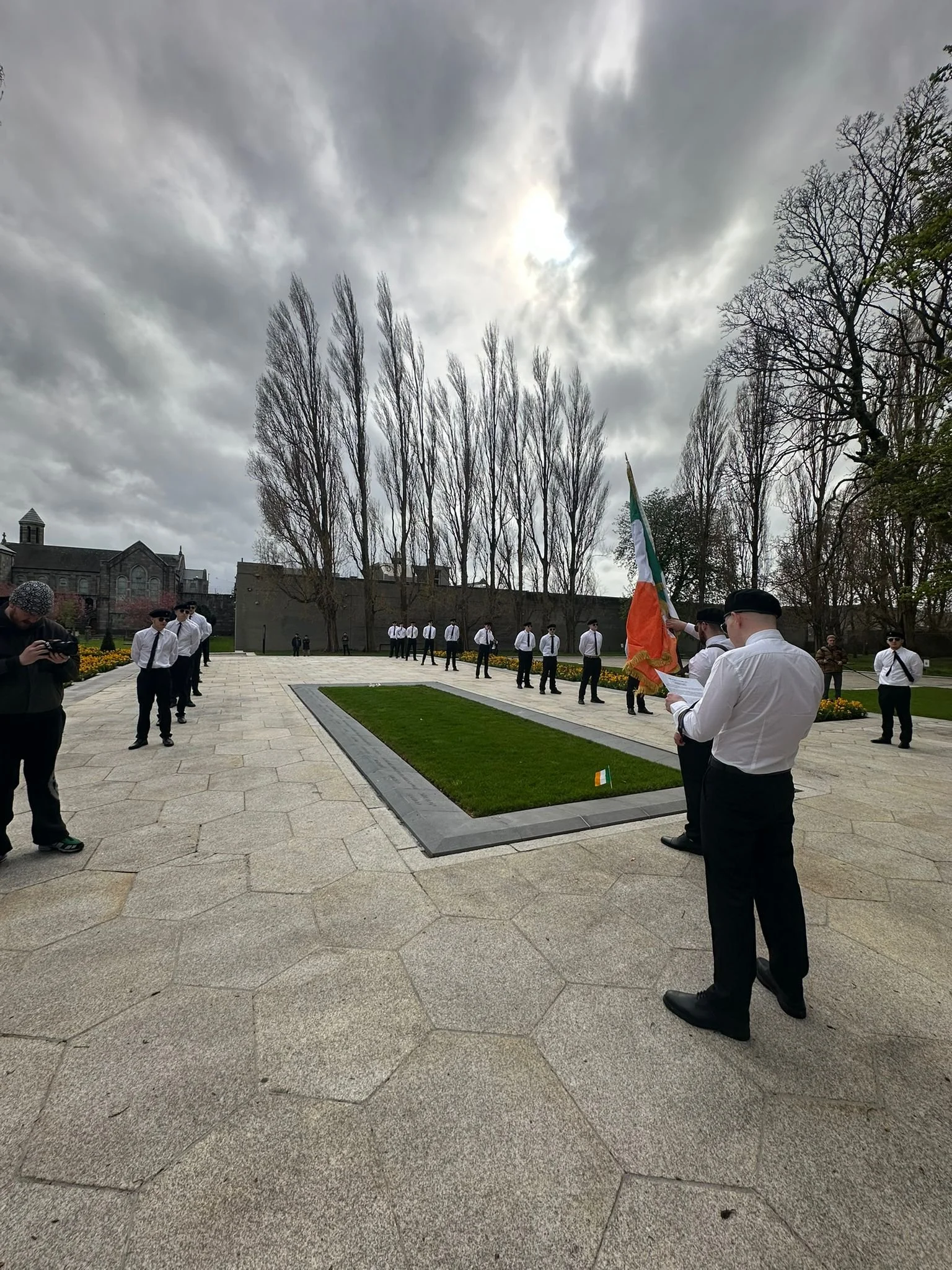
Members of Fronta Poblachtach at the graveside of the leaders of the 1916 Rising
The inaugural Fronta Poblachtach Easter commemoration was held on 04/04/2026.
The event was officiated by Adam Ó Raghallaigh
The colour party, under the command of Diolún MacConmhaoil and led by a single flag bearer carrying the National Flag, assembled at the entrance to the cemetery and proceeded in formation to the burial platform.
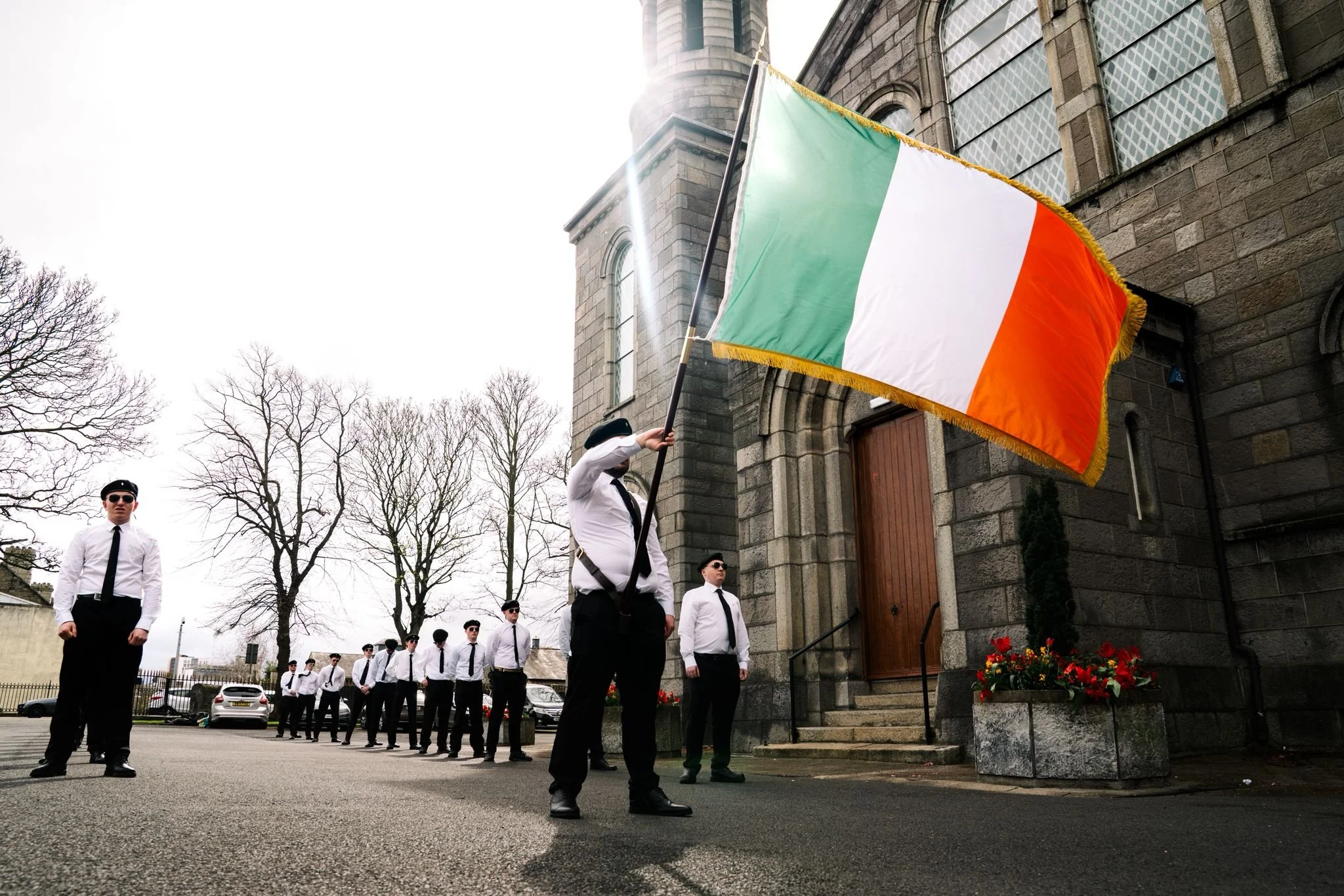
Michael Tuite leads the Colour Party
Ó Raghallaigh opens the commemoration:
“Dia daoibh a chairde,
I’d like to begin by welcoming you all to this Easter Commemoration, on the 110th anniversary of the Rising, organised by Fronta Poblachtach - The Republican Front.
It is the first such commemoration we have organised and it comes just shortly after the first anniversary of Fronta Poblachtach’s founding.
Only a short while ago it would have been unimaginable that we’d have such a display of youth with great capability advocating for the Republican cause - and long may it continue.
I’d like to begin by inviting Ciarán McErlean to read the 1916 Proclamation”
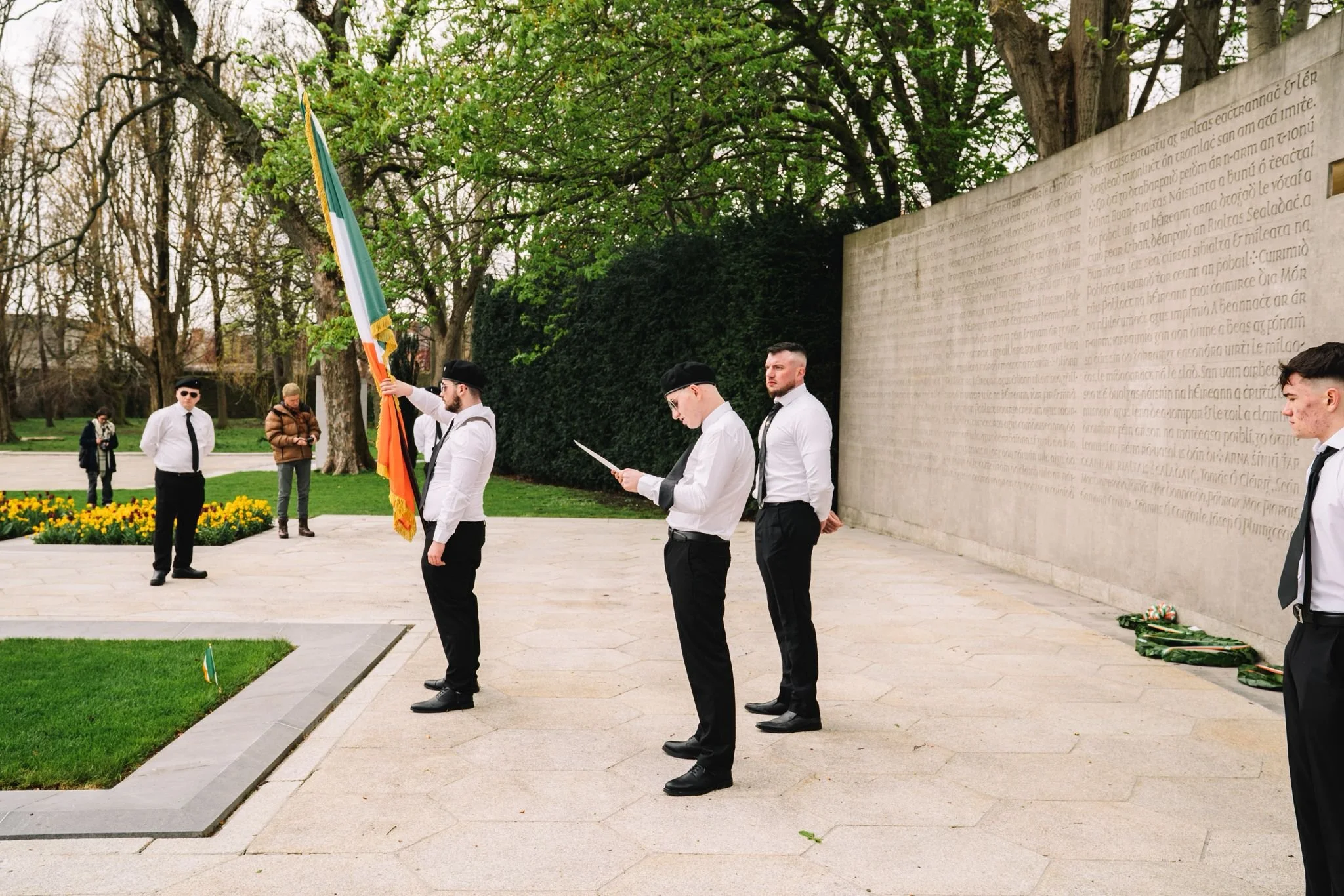
Ciarán McErlean reads the Proclamation
“Thanks Ciarán. I would now like to invite Jack Culinan of Cork to lay a wreath on behalf of Fronta Poblactach/The Republican Movement
I’d now like to ask for a minute’s silence
(Flag lowered then raised)
[ Ar Éireann then plays for 1 minute as Michael lowers the flag, and raises it again]
“I would now like to invite Stephen Delaney to give a short speech and read a poem regarding the Risin”
-
Dia daoibh a cháirde.
We assemble here today to pay our respects to those who gave their all for Irish Freedom in 1916, and to those who sacrificed their lives and freedom in the generations before and after.
I am going to read a short poem relating to the Rising, however I would first like to say a few words on a key issue which is often neglected today for the sake of convenience. That issue of course is National identity.
The Rising was carried out by men and women from all walks of life, carrying with them a broad array of beliefs. Despite this, they all shared one core value and dedicated themselves to realising it. That value, written here behind me in stone, is Nationhood. In the Irish context in particular, nationhood is intrinsically linked to our distinct ethnic and racial identity which spans the millennia, boasting one of the longest unbroken chains of continuity the world over. The key architects of the Proclamation had no qualms about invoking the Irish Race, and neither should we.
It serves well to remember the fact that those who authored the Proclamation believed it to be a cardinal truth that the Irish were indeed a distinct race and that they endeavoured towards our preservation as the dominant ethnic, political, social and cultural force on this island. The essence of Irish Republicanism and the 1916 Proclamation cannot be disentangled from this reality. We are the living Republic, it breathes when we breath, it perishes when we die. Anyone who would seek to detach this from Republican ideals is at best, gravely misguided.
This was important to the great heroes of the struggle for National Freedom in Ireland. Notably it has always also been very important to our adversaries. The Anglo-Saxons who once created caricatures of the Irish, specifically targeting racial characteristics they ascribed to us, today conspire to deny that such an ethnicity or race exists at all. The organs of the state which have acted always to diminish any prospect for freedom in Ireland, seek again to convince the children of the nation that we are mongrels!
These great minds of our historical record attached importance to the biological inheritance of the Gael, and our adversaries have always sought to undermine the same. We must reaffirm its central role in our guiding principles. The shared ethnicity of the Gael has always been the underpinning structure of our social cohesion, unity and solidarity; the Nation is, after all, a family grown large, not a melting pot of transient labour. It was Labour man James Connolly who told us In this hour of her trial Ireland cannot afford to sacrifice any one of the things the world has accepted as peculiarly Irish. She must hold to her highest thoughts, and cleave to her noblest sentiments. Her sons and daughters must hold life itself as of little value when weighed against the preservation of even the least important work of her separate individuality as a nation
After centuries of invasion, plantation and treachery, our race stands defiant against imperialism and the subjugation of our people. We recognise homogeneity as a source of strength as we reject globalisation and its erosion of all the sublime hereditary characteristics we possess. The attempts to disintegrate the Gael cannot prevail. This is our Homeland - we can know no other. We remember now more than ever the long stated goal of Republicanism is for an Ireland not merely free, but Gaelic as well.
The anger in Ireland today is rooted in this threat to our race. The Irish people are predisposed to it. To Quote Jeremiah O’Donovan Rossa: “And why shouldn't an Irishman be mad when he grows up face to face with the plunderers of his land and race, and sees them looking down upon him as if he were a mere thing of loathing and contempt!”
*Pauses for a brief period
The Rose Tree by William Butler Yeats
'O words are lightly spoken,'
Said Pearse to Connolly,
'Maybe a breath of politic words
Has withered our Rose Tree;
Or maybe but a wind that blows
Across the bitter sea.'
'It needs to be but watered,'
James Connolly replied,
'To make the green come out again
And spread on every side,
And shake the blossom from the bud
To be the garden's pride.'
'But where can we draw water,'
Said Pearse to Connolly,
'When all the wells are parched away?
O plain as plain can be
There's nothing but our own red blood
Can make a right Rose Tree.'
Go raibh míle maith Agaibh.
*Bualadh bos
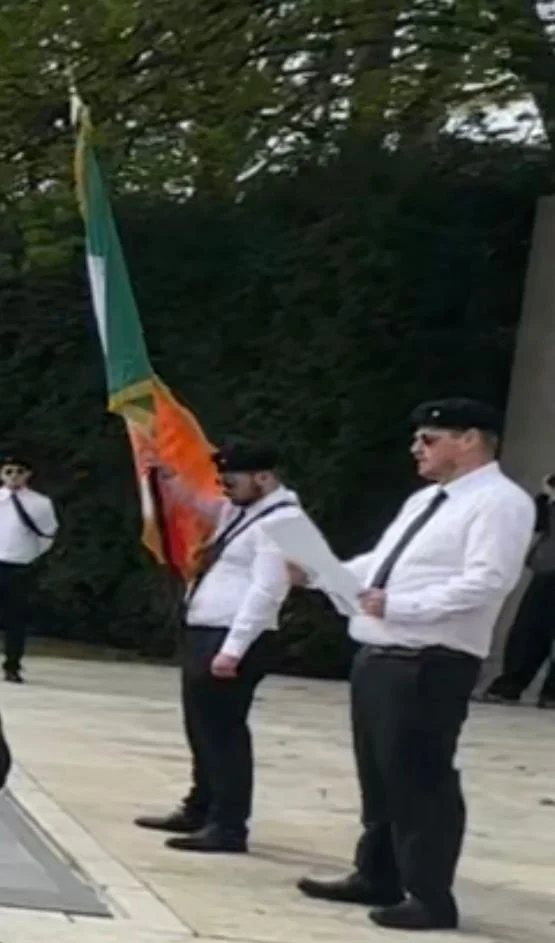
Stíofán Ó Dhubhsláine
“I would now like to invite Nathan Hastings to give the main oration”
-
A chairde,
I would like to begin by thanking you all for attending this commemoration today organised by Fronta Poblachtach. Only a short time ago it would have been impossible to imagine a gathering such as this of like-minded Republicans committed to fulfilling the Proclamation of 1916
This marks the 110th anniversary of the 1916 Rising, the participants of which- like many heroes of the generations before and after them, sought to overthrow foreign rule in Ireland and build a Republic which would see the freedom and material wellbeing of the Irish people put first.
The circumstances in which we find ourselves today are not far removed from those which existed over a century ago. The Easter Rising was carried out by a small band of committed Republicans in the face of overwhelmingly adverse conditions. Not least of all the military opposition and unfavourable public opinion. The Rising came at a time when Bitish Rule had been normalised to a great extent. Adverse conditions are, of course, not alien to us here. In spite of these circumstances, those who engaged in the Rising lit a spark which reverberated around Ireland and the world. With previous generations they fashioned the stake which we hold today, to be driven into the heart of those who would see the Irish people held in chains.
The leaders of 1916 and those who went onto form the framework for the First Dail, gave to us the synthesis of Irish Republicanism. It stipulates a free and sovereign Ireland, with the wellbeing of its people guaranteed, and the protection and promotion of our language, culture, history and traditions. Our objective remains to build an Ireland which is governed based on these principles.
This does not mean that we consign ourselves to recreating the past. The spirit of those who went before us serves as an inspiration; the principles that they laid down are the essence of Republicanism and illuminate the path we must follow. However, we are in different times, with different factors currently impacting the struggle for the Republic proclaimed in 1916.
Our primary aim at present is, of course, to build a force capable of furthering the Republican ideal. This means promoting Republicanism and drawing on what has always been its life blood: the working and dispossessed peoples, “The Men of No Property”. Those of us who have committed ourselves to Republicanism must continue to spread its message to these people so that we may form a movement capable of furthering the ideals of Tone, Emmett, Pearse and Connolly.
To make Republicanism a popular and effective force, we must acknowledge the current difficulties we face in terms of its image among working-class communities and shirk the practices which have been attached to it making it appear repugnant to those who must make it a living, breathing and popular force. This means returning Republicanism to what it actually is. It is not a niche subculture for the purposes of recreation. It is not some abstract ideal to which we can attach whimsical degenerate ideas surrounding so-called identity politics. It is not something to be used as a cloak for self-gain-based thievery and anti-community activities. It is not some morbid tradition to be carried on for the sake of it.
We must deal with the exigencies of our time and relate Republicanism to these. The great evil faced by Republicans, and by the working and dispossessed people of the world is not the British Empire alone. It is now merely a small cog in a global project to draw wealth increasingly to a small, borderless, globalist elite. Key to this has been the project of mass immigration and economic emigration. Irish workers and renters are to be replaced with those who are easier to exploit; our very existence as a distinct ethnicity is to be undermined, our sense of community solidarity, with our traditions, language and culture, are to be uprooted though gentrification so that our country may be conquered and converted to a grey, cosmopolitan hellscape with no unity or backbone to resist the will of the globalist elites.
The forces responsible for this will, where they cannot engage in such soft conquering of a native population, resort to sheer military force. The elites responsible for this control the government of our age-old adversary in Perfidious Albion, and also the USA, EU, the Zionist entity which calls itself Israel, and their allies. They are spear-headed by the NATO imperialist alliance. This is why we must give support to the countries and forces which resist the aggression of these entities. We share the same enemy.
Considering all of this, the challenges we face internally and externally, the importance of decisive action cannot be understated. This is our Thermopylae. The forces of imperialism are at the Hot Gates, those who have tried to ruin Republicanism from within are our Ephialtes. We must push back these forces, or at least provide the groundwork for those following us to do so.
In terms of the theory on what must be done, it is straightforward. Irish Republicanism in its modern sense is codified in the 1916 Proclamation and the Democratic Program of the First Dáil. These lay out the principles by which a Gaelic and Free Ireland must be governed. Our goal as Republicans is to set the concrete objectives, establish the strategy and build the vehicle capable of following that strategy to fulfill the ideals laid out by those who planted this idea as a seed and watered it with their blood.*Bualadh bos
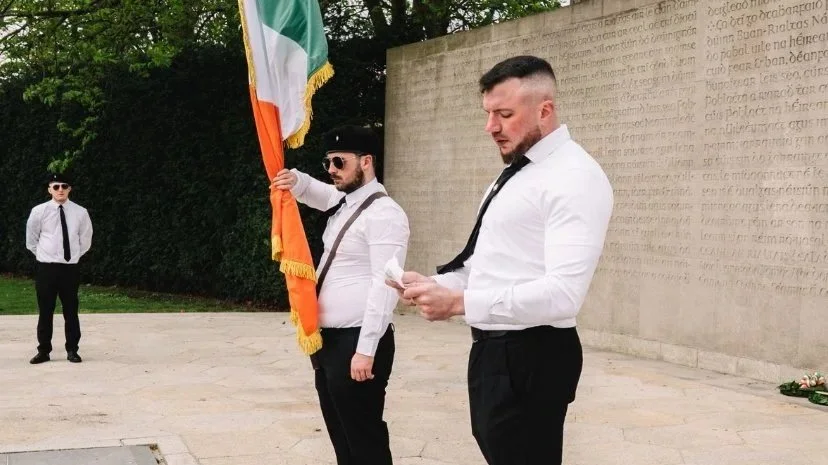
Nathan Ó Hóistin gives the main oration
“I would like to thank you all for coming here today, may we see more of this in the future. As I mentioned previously, it is only a short time ago that a gathering such as this would have been unimaginable. We are truly back.
Please everyone remain silent for the National Anthem”
National Anthem plays
*Bualadh bos
Ceremony ends
